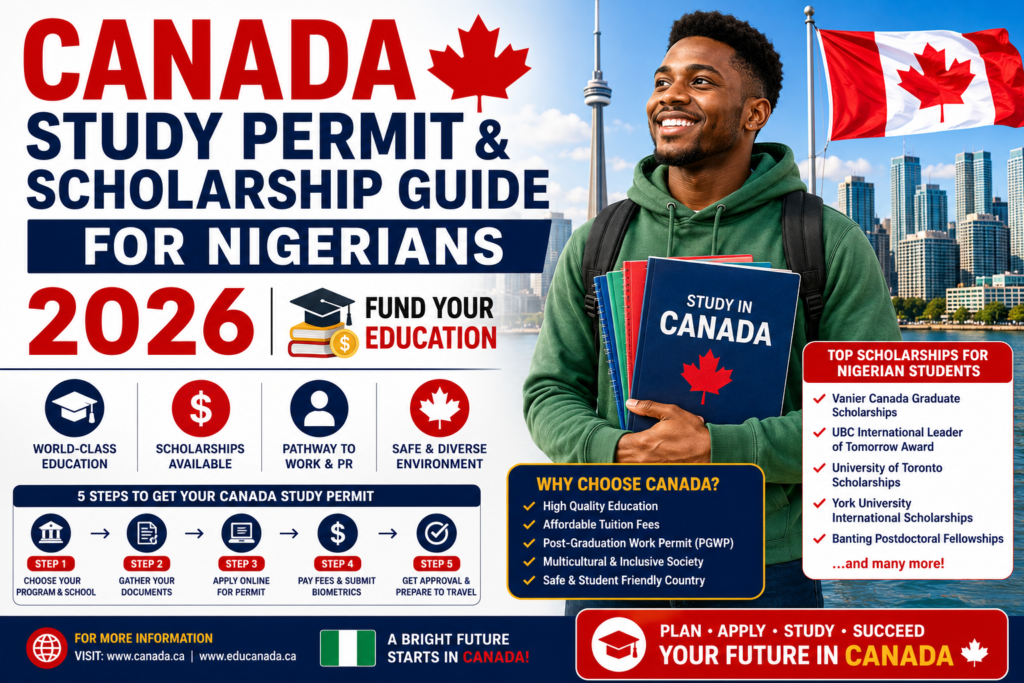

Here’s the brutal truth that catches most Nigerian students off guard: getting into a Canadian university is the easy part. The real wall is money — and not just tuition. To even get your study permit approved in 2026, you must prove you have CAD $20,635 for living costs (about ₦23 million) plus your full first-year tuition of CAD $20,000–$41,000 (₦22m–₦45m) sitting in an account. That’s a total of CAD $40,000–$60,000+ — roughly ₦44 million to ₦66 million — you must show before Canada lets you in.
For most Nigerian families, that number alone ends the dream. But here’s the powerful connection almost nobody explains: a scholarship doesn’t just pay for school — it solves your study permit problem too. A scholarship letter counts as proof of funds, slashing the money you must show and the money you must spend. This guide tackles both halves: exactly how the Canada study permit works for Nigerians in 2026 (costs in dollars and naira), and how scholarships fund your education and unlock your visa. Let’s get you to Canada, funded.
Part 1: The Study Permit — What It Actually Costs
Understand the permit first, because it’s where Nigerian applications most often fail. To study in Canada for any program over six months, you need a study permit, and in 2026 you need five things to get one:
| Requirement | Detail | Cost (CAD) | Naira (≈) |
|---|---|---|---|
| Acceptance Letter (DLI) | From a Designated Learning Institution | — | — |
| Provincial Attestation Letter (PAL) | From the province | — | — |
| Proof of funds | $20,635 living + first-year tuition | $40,000–$60,000+ | ₦44m–₦66m+ |
| Biometrics | Fingerprints & photo | $85 | ₦93,000 |
| Application fee | Study permit | $150 | ₦165,000 |
The killer requirement is proof of funds. As 2026 IRCC rules confirm, you must show a GIC or bank balance of at least CAD $20,635 (₦23m) for living costs, plus proof you can cover your first year’s tuition. So if your tuition is CAD $15,000, you must show at least CAD $37,895 total (₦42m); at CAD $25,000 tuition in Ontario, you need CAD $45,635 (₦50m). And as a Nigerian, expect extra scrutiny — bank statements going back several months and sometimes affidavits explaining where the money came from. Insufficient or poorly documented funds is the #1 reason Nigerian study permits are refused.
Note: Nigerians apply through the Nigeria Student Express (NSE) stream (not the SDS, which isn’t available in Nigeria), and a GIC — a Guaranteed Investment Certificate of about CAD $20,635, returned to you in installments after you arrive — is the strongest way to prove your living funds.
Part 2: How A Scholarship Solves The Money Wall
Now the game-changer. That intimidating ₦44–₦66 million proof-of-funds requirement is exactly why scholarships matter so much for Canada — they attack the problem from both sides.
A scholarship reduces what you must spend. A fully funded scholarship covering tuition wipes out the biggest line item — and a tuition-covering award means you no longer need to prove you have that tuition money, because the scholarship pays it.
A scholarship letter is accepted proof of funds. Crucially, IRCC explicitly accepts scholarship confirmation letters as part of your financial proof. So winning a scholarship doesn’t just save money — it directly strengthens your study permit application, removing the officer’s biggest doubt. As the funding guidance confirms, scholarship letters and confirmations are among the accepted documents demonstrating you won’t run out of money mid-studies.
So for a Nigerian, the smartest strategy is clear: secure a scholarship first, and it solves your funding and your visa simultaneously. The fully funded Canadian scholarships we’ve covered — from undergraduate awards to government and university funding — are the key that unlocks the whole process.
The Scholarships That Fund Your Canadian Education
Canada offers strong funding at every level, and the right award transforms your study permit odds. The headline options for Nigerians:
| Scholarship | Level | Coverage | Value (CAD) | Naira (≈) |
|---|---|---|---|---|
| Lester B. Pearson (U of T) | Undergrad | Full tuition + residence (4 yrs) | ~$180,000 | ₦200m |
| Vanier CGS | PhD | $50,000/yr × 3 | $150,000 | ₦165m |
| University full-ride awards | All levels | Tuition + living | varies | up to ₦200m |
| University entrance scholarships | Undergrad/Grad | Partial to substantial | $5,000–$40,000 | ₦5.5m–₦44m |
The flagship Lester B. Pearson International Scholarship (full tuition plus residence for four years, ~CAD $180,000 / ₦200m) and the Vanier Canada Graduate Scholarship (CAD $50,000/year for PhDs / ₦55m) lead the way, alongside generous university entrance awards from CAD $5,000–$40,000 (₦5.5m–₦44m). Even a partial award helps your proof of funds. We break these down fully in our guides to fully funded Canadian scholarships — and stacking one with the 20 hours/week of part-time work your study permit allows can cover your living costs entirely.
The Bigger Prize: Study Permit → Work → Permanent Residency
Here’s why this is worth every effort — a Canadian study permit is the on-ramp to staying. After graduating, you can get a Post-Graduation Work Permit (PGWP), gain Canadian work experience, and transition to permanent residency through Express Entry or a Provincial Nominee Program — a route we detail in our guide to migrating to Canada through Express Entry.
So your scholarship funds your degree, your study permit gets you in, your degree earns you a work permit, and your Canadian experience builds toward PR — with your family able to join you. A funded study permit isn’t just about education; it’s the first step of a complete immigration pathway. That’s why getting both halves right — the scholarship and the permit — matters so much.
Step-By-Step: Fund Your Canadian Education From Nigeria
Step 1 — Secure admission to a DLI. Apply to Designated Learning Institutions and get your acceptance letter and PAL.
Step 2 — Win a scholarship first if you can. Target Pearson, Vanier, and university awards — a tuition-covering scholarship slashes both your costs and your proof-of-funds burden.
Step 3 — Prepare your proof of funds carefully. Build a GIC (~CAD $20,635) and document your tuition funds, with clean bank statements going back several months (Nigerians face extra scrutiny — start early).
Step 4 — Write a strong Statement of Purpose showing genuine study intent and ties to Nigeria (a weak SOP is a top refusal reason).
Step 5 — Sit IELTS (budget around ₦300,000) if required by your institution.
Step 6 — Apply for the study permit (CAD $150 + $85 biometrics) via the Nigeria Student Express stream; processing takes 4–16 weeks.
Step 7 — Arrive, study, work part-time, then pursue PGWP and PR. Never pay an agent for a “guaranteed” permit or scholarship — apply through IRCC and official scholarship portals only.
Frequently Asked Questions
How much money do I need for a Canada study permit in 2026? You must show proof of funds of at least CAD $20,635 (₦23m) for living costs, plus your full first-year tuition (CAD $20,000–$41,000 / ₦22m–₦45m). That’s a total of roughly CAD $40,000–$60,000+ (₦44m–₦66m+), plus the $150 application fee and $85 biometrics. Nigerians face extra financial scrutiny.
Can a scholarship help my Canada study permit application? Yes, significantly. A scholarship confirmation letter is accepted by IRCC as proof of funds, and a tuition-covering scholarship reduces the money you must show and spend. Winning a scholarship strengthens your study permit application by removing doubts about your finances — solving funding and visa together.
What scholarships can fund my education in Canada? Top options include the Lester B. Pearson International Scholarship (full tuition + residence, ~CAD $180,000 / ₦200m), the Vanier CGS for PhDs (CAD $50,000/yr / ₦55m), and university entrance awards (CAD $5,000–$40,000 / ₦5.5m–₦44m). Even partial awards help your proof of funds.
Do Nigerians use the Student Direct Stream (SDS) for Canada? No. The SDS is not available in Nigeria; Nigerians apply through the Nigeria Student Express (NSE) stream. A GIC of about CAD $20,635 — strongly recommended — serves as proof of your living funds and is returned to you in installments after you arrive.
Can a study permit lead to permanent residency? Yes. After graduating, you can obtain a Post-Graduation Work Permit (PGWP), gain Canadian work experience, and transition to permanent residency through Express Entry or a Provincial Nominee Program. A funded study permit is the first step of a full pathway to living in Canada permanently.
Final Word: Solve The Money, And Canada Opens
Come back to that wall — the CAD $40,000–$60,000+, the ₦44 to ₦66 million you must prove and spend just to get a Canadian study permit approved as a Nigerian. It’s the real barrier, far more than admission, and it’s where most dreams stall. But now you know the key that unlocks it: a scholarship solves both halves at once — it pays your tuition and serves as the proof of funds that wins your permit. Win the funding, and the money wall simply falls.
So work the two halves together. Secure admission to a DLI, chase a scholarship (Pearson, Vanier, university awards) to slash your costs and strengthen your visa, build a properly documented GIC and proof of funds, write a convincing Statement of Purpose, and apply through the Nigeria Student Express stream. Get it right and you don’t just fund a degree — you start a pathway that runs from study permit to work permit to permanent residency, with your family alongside you. Never pay an agent for a “guaranteed” permit; do it properly through official channels.
To verify current requirements and apply through the only legitimate channel, go to the authoritative source — the official Government of Canada study permit pages on IRCC, which publish the real proof-of-funds figures, PAL rules, and application portal. And to fund the whole thing, pair this with our complete guide to applying for fully funded scholarships abroad from Nigeria and your future Express Entry route to Canadian permanent residency — because in Canada, your scholarship, your study permit, and your immigration future are all one connected plan.