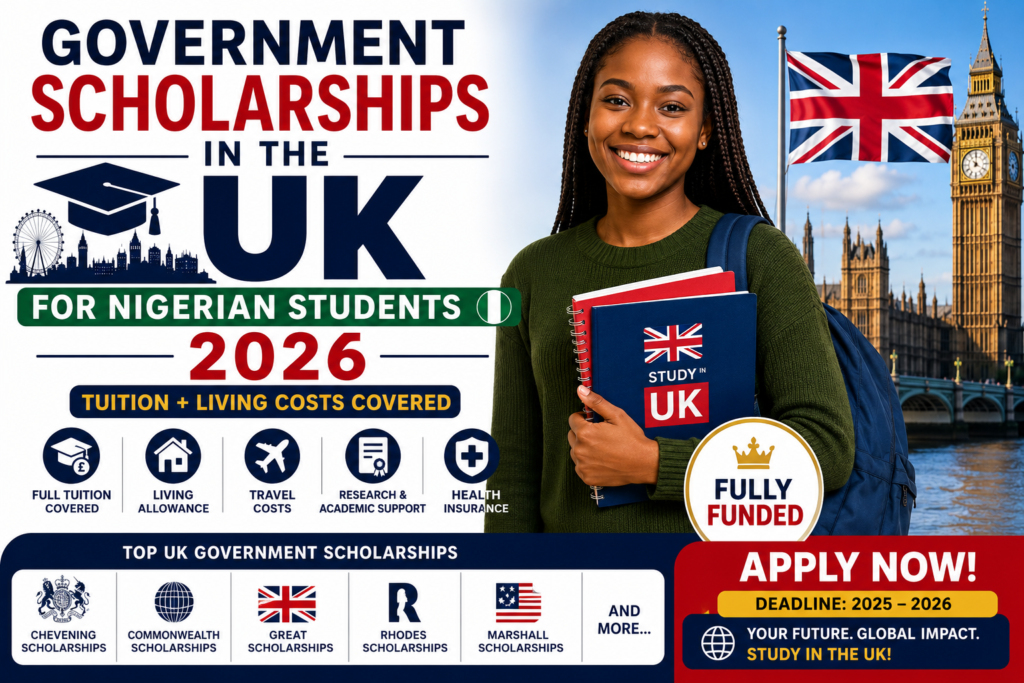

When a Nigerian dreams of a UK degree, the maths is brutal: tuition of £20,000–£38,000 a year (roughly ₦40 million to ₦76 million), plus living costs of around £12,000–£15,000 (₦24m–₦30m) on top, in a year when the naira makes every pound punishing. Privately funding it is out of reach for almost everyone. But here’s what changes the equation entirely: the UK government itself funds scholarships that cover all of it — full tuition and living costs and flights and visa fees — for Nigerian students, every single year.
These aren’t university discounts or private foundations. They’re scholarships funded directly by the UK Foreign, Commonwealth and Development Office (FCDO) — government money, designed to bring talented Nigerians to Britain at zero cost to them. There are three that matter, worth from £10,000 to over £70,000 (₦20m–₦140m), and this guide breaks down exactly what each covers in pounds and naira, who qualifies, the tuition-plus-living-costs packages, and how a Nigerian applies. Let the UK government pay for your degree.
Government Money vs Everything Else: Why It Matters
First, understand the distinction that defines this guide. UK scholarships come from three sources: universities (their own merit/need awards), private foundations (like Gates Cambridge), and the UK government (the FCDO). This article focuses on that third category — government scholarships — because they’re the most generous, the most prestigious, and specifically built to fund students from developing Commonwealth countries like Nigeria.
As scholarship guidance confirms, the UK offers fully funded scholarships through government programs like Chevening and Commonwealth, alongside university-specific awards — and the government ones typically cover tuition, living expenses, airfare, and other allowances. The advantage of targeting government scholarships is that they’re explicitly designed for international students from countries like yours, with development and leadership goals that play to a Nigerian applicant’s strengths. Here are the three that count.
The Big Three UK Government Scholarships
| Scholarship | Funder | Level | Coverage | Value/Year |
|---|---|---|---|---|
| Chevening | FCDO | Master’s | Full tuition + flights + living + visa | £35,000+ (₦70m+) |
| Commonwealth | FCDO/CSC | Master’s & PhD | Full tuition + flights + stipend | £35,000+ (₦70m+) |
| GREAT Scholarships | FCDO/British Council | Master’s | £10,000 toward tuition | £10,000 (₦20m) |
Chevening is the UK government’s flagship. Funded by the FCDO, it fully funds a one-year UK master’s at any UK university, covering full tuition fees, return airfare, visa fees, and a monthly living allowance of approximately £1,300–£1,500 (about ₦2.6m–₦3m monthly) — a total package exceeding £35,000 (₦70m). Its focus is leadership and career impact, and it requires a bachelor’s degree plus two years of work experience. The application window runs roughly August to early October each year.
Commonwealth Scholarships, also FCDO-funded (via the Commonwealth Scholarship Commission), cover full tuition, return flights, and a monthly living stipend for both master’s and PhD study — with no bond or repayment required. The difference from Chevening: Commonwealth emphasises academic merit and development impact rather than work experience, and Nigerians apply through the Federal Scholarship Board or approved universities. You need a Second Class Upper (2:1) for master’s (a relevant master’s for PhD).
GREAT Scholarships — jointly funded by the FCDO/British Council and UK universities under the GREAT Britain Campaign — are smaller but valuable: £10,000 toward tuition (₦20m) for a one-year postgraduate course, across fields like law, science, and business. Not fully funded, but a substantial, more attainable government award you can combine with other funding. (For example, the University of Southampton’s GREAT Scholarship for Nigeria gives £10,000 off tuition, with an April 2026 deadline.)
What “Tuition + Living Costs” Really Covers (In Naira)
The phrase “fully funded” gets thrown around loosely, so here’s exactly what the two full government scholarships (Chevening and Commonwealth) put in your pocket — and it’s comprehensive:
| Cost Covered | Typical Value | Naira (≈) |
|---|---|---|
| Tuition fees | £20,000–£38,000 | ₦40m–₦76m |
| Monthly living allowance | £1,300–£1,500/mo | ₦2.6m–₦3m/mo |
| Annual living total | £15,600–£18,000 | ₦31m–₦36m |
| Return airfare (Nigeria–UK) | £800–£1,500 | ₦1.6m–₦3m |
| Visa & IHS fees | £1,000+ | ₦2m+ |
| Total package | £35,000–£55,000+ | ₦70m–₦110m+ |
That’s a complete package worth ₦70 million to over ₦110 million a year — tuition wiped out, a ₦2.6–₦3 million monthly allowance to live on, your flights paid, and your visa covered. For a Nigerian family staring down those costs privately, a government scholarship doesn’t just help; it removes the entire financial barrier. You arrive, study, and live, funded by the UK government.
Who Qualifies — And One Nigerian Government Bonus
The requirements across these government awards:
Strong academics — typically a 2:1 (Second Class Upper) or First Class for the full awards. English proficiency — IELTS, though a Medium of Instruction (MOI) letter or alternatives (WAEC English, Duolingo) may be accepted, since Nigerians study in English (budget around ₦300,000 if you sit IELTS). A compelling personal statement — leadership and career impact for Chevening; academic merit and development goals for Commonwealth. Work experience — two years for Chevening (none required for Commonwealth or GREAT). The right documents — passport, transcripts, certificates, CV, references, NYSC certificate. And a two-year return commitment to Nigeria for Chevening and Commonwealth.
One bonus worth knowing: beyond UK-government money, the Nigerian government’s PTDF scholarship (Petroleum Technology Development Fund) also funds Nigerians for UK master’s and PhD study in energy-related fields — a “government scholarship” from your own side. Worth checking if your field fits.
Step-By-Step: How A Nigerian Wins One
Step 1 — Target by your profile. Working professional with 2+ years’ experience and leadership → Chevening. Strong academic with a development goal (and maybe no work experience) → Commonwealth. Want a solid, attainable top-up → GREAT (£10,000).
Step 2 — Note the windows. Chevening: August–early October. Commonwealth: via the Federal Scholarship Board (earlier internal deadline). GREAT: varies by university (e.g. April 2026 at Southampton). Diarise and work backwards.
Step 3 — Secure UK university admission where required (Commonwealth often wants admissions in hand).
Step 4 — Sort English — IELTS or an MOI waiver.
Step 5 — Write a powerful, tailored personal statement — leadership for Chevening, development impact for Commonwealth.
Step 6 — Apply through official channels only — Chevening’s portal, the CSC/Federal Scholarship Board for Commonwealth, the British Council/university for GREAT. Never pay an agent; these government scholarships are free to apply for. Use the proven system in our complete guide to applying for fully funded scholarships abroad.
Frequently Asked Questions
What UK government scholarships are available for Nigerian students in 2026? Three main FCDO-funded awards: Chevening (fully funded one-year master’s), Commonwealth Scholarships (fully funded master’s and PhD), and GREAT Scholarships (£10,000 toward tuition). Chevening and Commonwealth cover full tuition, living costs, flights, and visa fees; GREAT is a partial tuition award.
How much do UK government scholarships cover in naira? The full awards (Chevening, Commonwealth) cover tuition (£20,000–£38,000 / ₦40m–₦76m), a monthly living allowance of £1,300–£1,500 (₦2.6m–₦3m), flights, and visa fees — a total package of £35,000–£55,000+ (₦70m–₦110m+) a year. GREAT provides £10,000 (₦20m) toward tuition.
What’s the difference between Chevening and Commonwealth? Both are FCDO-funded and fully cover tuition plus living costs. Chevening requires two years of work experience and focuses on leadership, funding one-year master’s. Commonwealth requires no work experience, emphasises academic merit and development impact, funds both master’s and PhD, and is applied for via Nigeria’s Federal Scholarship Board.
Do UK government scholarships require work experience? Chevening requires at least two years of work experience. Commonwealth Scholarships and GREAT Scholarships do not — they focus on academic merit, making them ideal for strong recent Nigerian graduates without significant work history.
Do I have to return to Nigeria after the scholarship? For Chevening and Commonwealth, yes — both require a commitment to return to Nigeria for at least two years after completing your studies, as they’re development-focused government awards. GREAT has no such bond. None require repayment of the scholarship.
Final Word: Let The Government Pay The Pounds
Come back to that brutal maths — £20,000–£38,000 tuition (₦40m–₦76m) plus ₦24–₦30 million in living costs, in a naira economy that makes self-funding a UK degree almost impossible. That wall is exactly what UK government scholarships are built to demolish. Chevening and Commonwealth don’t reduce the cost — they erase it, covering your full tuition, handing you ₦2.6–₦3 million a month to live on, flying you over, and paying your visa, in packages worth ₦70 million to over ₦110 million a year. GREAT adds a solid ₦20 million tuition cut on top.
This is government money, designed for Nigerians, awarded on merit and not on connections or wealth. Target the right one for your profile — Chevening if you have work experience and leadership, Commonwealth if you’re a strong academic with a development vision, GREAT for an attainable top-up. Respect the deadlines, secure admission, sort your English, write a statement that shows purpose, and apply only through official channels for free. The UK government is genuinely willing to pay for your degree — your job is simply to apply, and apply well.
To verify deadlines and apply through the only legitimate channels, go to the authoritative source — the official British Council Study UK scholarships portal, which lists Chevening, Commonwealth, and GREAT scholarships open to Nigerian students. And because the strongest applicants apply widely, pair this with the Gates Cambridge & Rhodes deep-dive for the top private/foundation awards, and our complete guide to applying for fully funded scholarships abroad from Nigeria to maximise your odds across every funded route.