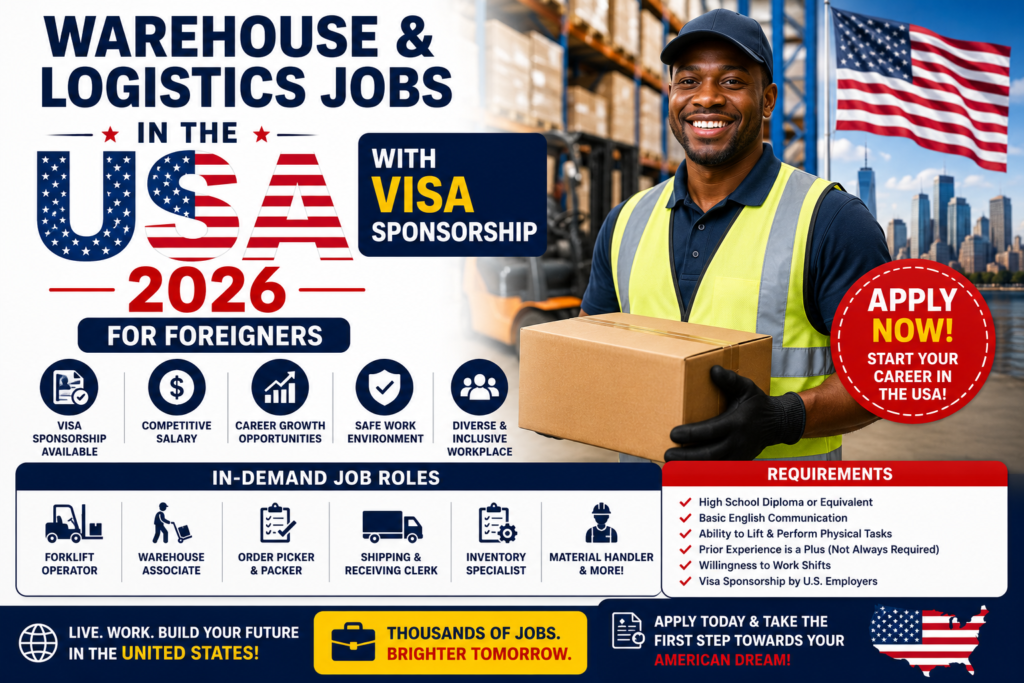

Here’s a route into America that needs no degree, accepts beginners, and can end with a US green card in your hands: working in a warehouse. In 2026, giants like Amazon, Walmart, FedEx, UPS, and Costco are sponsoring thousands of foreign workers a year for packing, forklift, sorting, and shipping roles — paying $31,000 to $60,000 a year (roughly ₦46 million to ₦90 million with overtime), often training you after you arrive. For a hardworking Nigerian without university credentials, warehouse and logistics work is one of the most accessible, permanent-residency-bound paths into the United States that exists.
But the visa route decides everything — and most adverts won’t tell you the difference. Some warehouse jobs lead to a permanent green card (EB-3); others are just temporary seasonal work (H-2B) that ends after a year. Pick wrong and you miss the green card entirely. This guide breaks down both routes, the real salaries in dollars and naira, the companies that actually sponsor, the requirements, and the step-by-step path from Nigeria. Let’s get you on the warehouse green-card ladder.
Why US Warehouses Are Hiring Foreigners
Understand why this opportunity is real and not hype. The US warehouse and logistics industry is the engine room of the economy, and in 2026 it’s expanding rapidly — driven by e-commerce growth, new distribution centres, and nationwide labour shortages. The warehousing and storage sector is projected to grow over 10% in just a few years, and employers simply can’t find enough US workers to fill the roles.
That shortage is why the biggest names sponsor foreigners. As 2026 industry data confirms, major companies like Amazon, Walmart, FedEx, Costco, and UPS continue to hire thousands of international workers each year under EB-3 and H-2B visas — even for applicants with no degree or limited English. The demand is genuine, the pay is solid in naira terms, and one route leads to permanent residency. Now let’s get the routes right.
The Two Routes: EB-3 (Green Card) vs H-2B (Temporary)
This is the decision that shapes your whole future. Entry-level warehouse sponsorship runs through two very different visas:
| Visa Route | Type | Salary (USD/yr) | Naira (≈) | Leads To |
|---|---|---|---|---|
| EB-3 (unskilled) | Permanent | $31,000–$50,000 | ₦46m–₦75m | Green card (PR) |
| H-2B | Temporary/seasonal | $33,000–$45,000 | ₦49m–₦67m | Temporary (~1 yr, extendable) |
| H-1B / TN | Skilled (analysts/managers) | $80,000–$223,000 | ₦120m–₦334m | Possible green card |
The EB-3 unskilled route is the prize — and the one most Nigerians should target. It’s an employment-based green card path for full-time, permanent warehouse roles requiring less than two years of training. As EB-3 specialists confirm, it provides permanent residency, running through PERM labour certification → I-140 petition → consular processing, with your spouse and children able to join you. EB-3 positions typically start at $15–$19 per hour ($31,000–$40,000/year, ₦46m–₦60m), and with overtime many workers earn $40,000–$60,000 (₦60m–₦90m). It’s slower than temporary visas, but it ends in a green card and lifetime stability.
The H-2B visa is the temporary alternative — used heavily for seasonal warehouse spikes (think Amazon and FedEx peak periods). You can stay up to a year, extendable, but it doesn’t directly lead to a green card. Here’s the insider tip from workers who’ve done it: take an H-2B role, then ask your employer “Do you offer EB-3 sponsorship after one year?” Many successful immigrants started on H-2B and had their employer file their green card later. If an employer hesitates on EB-3, keep looking.
H-1B/TN only applies to skilled supply-chain roles — logistics analysts, supply-chain architects, operations managers — which pay far more ($80,000–$223,000, ₦120m–₦334m) but require degrees and experience. Not for entry-level work.
The Roles And What They Pay (In Naira)
Here are the specific warehouse and logistics roles hiring foreigners in 2026, with salaries in dollars and naira:
| Role | Salary (USD/yr) | Naira (≈) | Common Visa |
|---|---|---|---|
| Supply Chain Analyst/Manager | $80,000–$150,000 | ₦120m–₦225m | H-1B / TN |
| Forklift Operator | $35,000–$50,000 | ₦52m–₦75m | EB-3 / H-2B |
| Warehouse Team Lead | $40,000–$55,000 | ₦60m–₦82m | EB-3 |
| Shipping/Receiving Clerk | $34,000–$46,000 | ₦51m–₦69m | EB-3 |
| Package Handler / Sorter | $33,000–$45,000 | ₦49m–₦67m | EB-3 / H-2B |
| General Warehouse Associate | $31,000–$42,000 | ₦46m–₦63m | EB-3 / H-2B |
Forklift operators are in especially high demand — the US faces a significant forklift-operator shortage as e-commerce booms, and certified operators stand out to sponsors. Even the entry-level general associate at $31,000 (₦46 million) is transformative in naira terms for no-degree work, and with overtime (common in warehouses) real earnings climb well past the base. The roles are physical and shift-based, but the pay and the green-card route make them genuinely worthwhile.
The Requirements (Low-Barrier By Design)
Warehouse work is accessible precisely because the bar is low. To get sponsored you typically need: a full-time, permanent job offer from a sponsoring employer (essential for EB-3); no US degree — these are unskilled/entry roles; basic functional English (enough to follow safety instructions — very achievable for Nigerians); physical fitness for shift work; and a valid passport, police clearance, and medical exam. Many employers train you after arrival, so prior warehouse experience often isn’t required.
A smart, cheap edge: get an OSHA-approved forklift certification (an online course costs around $150, ₦220,000). Forklift skills are in high demand, make you stand out to sponsors, and can lift your pay — a small investment with a real return.
Step-By-Step: How A Nigerian Gets Sponsored
Step 1 — Target EB-3 for permanence. If your goal is to settle in America, pursue EB-3 unskilled warehouse roles (green card) over temporary H-2B. If you take H-2B, confirm the employer offers EB-3 after a year.
Step 2 — Target the big sponsors. Amazon, Walmart, FedEx, UPS, and Costco all sponsor under EB-3 — focus your applications there and on large distribution centres.
Step 3 — Boost your profile cheaply. Get an OSHA forklift certificate (~$150), and prepare a clean, direct CV (forget fancy formatting — employers want reliability).
Step 4 — Search the right way. Use Indeed, ZipRecruiter, and employer career pages, filtering for “EB-3 sponsorship,” “visa sponsorship,” and “H-2B warehouse.” Avoid any listing promising “guaranteed visas” or demanding upfront fees.
Step 5 — Secure a job offer; let the employer file. For EB-3, the employer completes PERM labour certification and files the I-140 — their responsibility and cost.
Step 6 — Complete consular processing at the US Embassy in Lagos or Abuja, then relocate.
Step 7 — Be realistic and safe. EB-3 is permanent but slow — expect a wait, as per-country green card backlogs affect Nigerians. And never pay an employer or agent for sponsorship; legitimate employers don’t sell job offers. Large upfront fees are always a scam.
Frequently Asked Questions
Can foreigners get warehouse jobs in the USA with visa sponsorship in 2026? Yes. Major employers like Amazon, Walmart, FedEx, UPS, and Costco sponsor thousands of foreign warehouse and logistics workers annually, mainly through the EB-3 visa (which leads to a green card) and the temporary H-2B visa. No degree is required, and many employers train you after arrival.
How much do US warehouse jobs pay foreigners in naira? Entry-level roles pay $31,000–$45,000 a year (₦46m–₦67m), rising to $40,000–$60,000 (₦60m–₦90m) with overtime. Forklift operators and team leads earn $35,000–$55,000 (₦52m–₦82m), while skilled supply-chain analysts and managers on H-1B earn $80,000–$223,000 (₦120m–₦334m).
Which warehouse visa leads to a US green card? The EB-3 unskilled visa. It sponsors permanent, full-time warehouse roles directly toward a green card, with family included, via PERM labour certification and an I-140 petition. The H-2B visa is only temporary (about a year) and doesn’t directly lead to permanent residency — though some H-2B workers later get EB-3 sponsorship.
Do I need a degree or experience for warehouse jobs? No. Warehouse and logistics roles require no US degree and often no prior experience — many employers train you after arrival. You need basic English, physical fitness, and a clean record. An OSHA forklift certification (~$150 / ₦220,000) is a cheap way to stand out.
Do I have to pay for warehouse visa sponsorship? No. Legitimate employers cover sponsorship costs and never sell job offers. Anyone demanding large upfront fees or promising “guaranteed visas” is running a scam. Apply through verified employer pages and reputable job boards, and confirm the company follows official USCIS procedures.
Final Word: Climb The Warehouse Green-Card Ladder
Come back to that route from the start — a no-degree warehouse job that pays up to ₦90 million with overtime and can end with a US green card. For a Nigerian willing to do honest, physical work, the warehouse and logistics sector is one of the most genuine, accessible permanent pathways into America in 2026. The labour shortage is real, the biggest companies in the country are sponsoring, and the EB-3 route turns a packing or forklift job into permanent residency for you and your family.
The single decision that defines your journey is the visa route. Target EB-3 for the green card; if you start on H-2B, confirm the employer will sponsor EB-3 after a year. Aim at the proven sponsors — Amazon, Walmart, FedEx, UPS, Costco — boost your odds with a cheap OSHA forklift certificate, apply through verified channels, and let the employer handle the petition. Be patient with the EB-3 timeline, and never pay a kobo for “guaranteed” sponsorship. Get it right, and a warehouse job becomes the first rung on a ladder that leads all the way to a green card.
To verify the green card route and apply through legitimate channels, go to the authoritative source — the official USCIS EB-3 employment-based immigration pages, which publish the real requirements straight from the US government. And because the smartest applicants compare routes, see how US hospitality jobs with visa sponsorship and US tech jobs with H-1B sponsorship compare — because the best route into America depends entirely on your skills and goals.